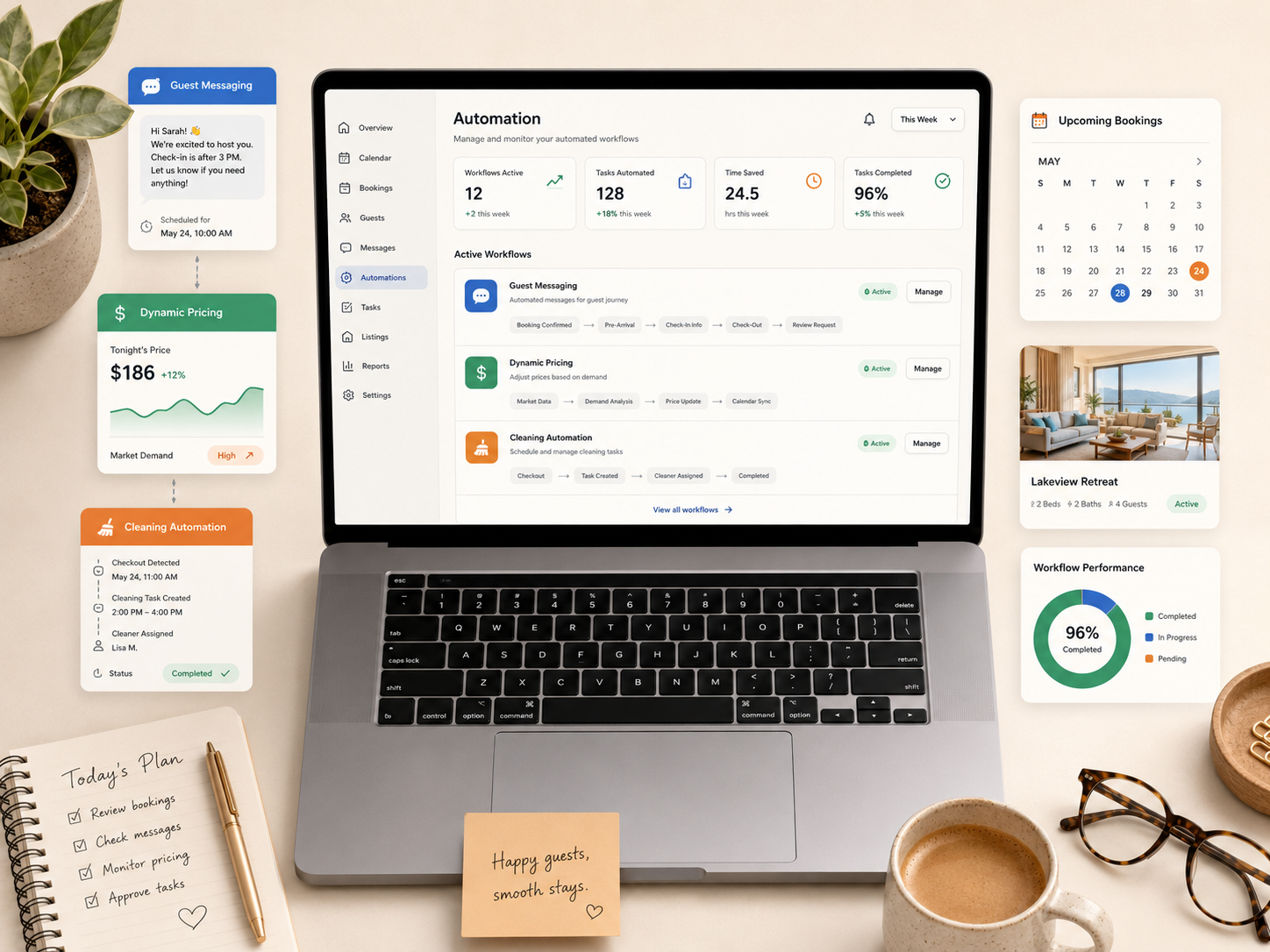
Running a short-term rental used to mean answering every guest message at midnight, manually blocking calendars across three platforms, and double-checking that the cleaner actually showed up. The hosts who are scaling past one or two units in 2026 have stopped doing all of that by hand. They lean on vacation rental automation tools to handle the repetitive work so they can focus on guest experience and growth instead of busywork.
In this guide, we’ll walk through the categories of vacation rental automation tools every host should know about, the specific platforms worth trying in each category, and how to decide which pieces of your operation are worth automating first. Whether you’re managing a single Airbnb listing or a growing portfolio, there’s a tool here that will save you hours every week.
Why Vacation Rental Automation Tools Matter in 2026
Guest expectations have risen sharply. According to STR Insights research on short-term rental operations, hosts who respond to inquiries within an hour book significantly more often than those who reply within a day. At the same time, the average host is juggling more listings, more platforms, and more compliance requirements than ever before.
Vacation rental automation tools close that gap. They let a single host — or a small team — operate like a much larger company by automating the tasks that don’t need a human touch: sending check-in instructions, adjusting nightly rates, syncing calendars, scheduling cleaners, and flagging issues before they become bad reviews.
The Core Categories of Vacation Rental Automation
Not every automation tool does the same job. Before picking software, it helps to understand the categories that make up a fully automated stack.
1. Property Management Systems (PMS)
A property management system is the backbone of vacation rental automation tools. It centralizes reservations, automates guest messaging, syncs calendars across Airbnb, Vrbo, and Booking.com, and often includes built-in task automation for cleaning and maintenance.
Hostaway is one of the most complete options here, with automated messaging sequences, multi-channel calendar sync, and reporting that updates in real time. It’s a strong fit for hosts who want one dashboard to control everything. Try Hostaway free →
Guesty is another heavyweight in this space, particularly popular with property managers running larger portfolios. Its automation engine handles guest communication, task assignment, and revenue workflows, and it integrates with a wide range of third-party tools. Explore Guesty →
2. Dynamic Pricing Engines
Manually adjusting rates for seasonality, local events, and demand swings is one of the most time-consuming parts of hosting. Dynamic pricing tools automate this by pulling in market data and adjusting your nightly rate automatically, often multiple times a day. If you’re not sure where to start, our guide on PriceLabs vs Beyond Pricing vs Wheelhouse breaks down the top options in detail.
3. Guest Messaging Automation
Automated messaging is arguably the single highest-leverage piece of vacation rental automation tools. Pre-written templates trigger automatically at booking, before check-in, during the stay, and after checkout, covering everything from Wi-Fi passwords to checkout reminders. Most modern PMS platforms, including Hostaway and Guesty, build this directly into their core product.
4. Cleaning and Turnover Scheduling
Cleaning automation tools automatically notify your cleaning team the moment a checkout is confirmed, track turnover completion with photo proof, and rebook a backup cleaner if someone cancels last minute. This category has matured quickly as more hosts manage remote properties without being on-site themselves.
5. Smart Home and Access Automation
Keyless entry systems, smart thermostats, and noise-monitoring sensors round out the physical side of vacation rental automation tools. These devices reduce the number of in-person tasks a host needs to handle, like meeting guests for key handoffs or worrying about energy costs between bookings.
6. Revenue and Reporting Dashboards
Beyond pricing, hosts running multiple units need a clear view of how each property is performing. Automated reporting tools pull occupancy, ADR, and net revenue data into a single dashboard, removing the need to manually reconcile numbers across Airbnb, Vrbo, and direct booking channels. This is especially valuable for hosts who report to investors or co-host partners and need consistent, automatically updated figures every month.
7. Damage Protection and Verification
Automated guest verification and damage protection tools screen bookings before they’re confirmed, flagging risky reservations based on guest history and behavioral signals. Some platforms also automate the claims process if something does go wrong during a stay, cutting down the back-and-forth that used to eat up a host’s afternoon.
How to Choose the Right Vacation Rental Automation Tools for Your Portfolio
The right mix depends heavily on portfolio size. A host with one or two listings might only need messaging automation and a pricing tool layered on top of a simple booking calendar. A host managing ten or more units typically needs a full PMS like Hostaway or Guesty that bundles messaging, channel sync, and reporting into a single automated workflow.
Start by listing the tasks eating the most of your time each week. If it’s guest questions, prioritize messaging automation. If it’s pricing decisions, start with a dynamic pricing tool. If it’s coordinating cleaners across properties, a turnover automation platform should be next on your list. Stacking too many disconnected tools at once often creates more admin work than it saves, so it’s worth checking how well candidate platforms integrate with each other before committing.
For a broader framework on evaluating software vendors, our vacation rental PMS buyer’s guide walks through the questions to ask before signing a contract.
What a Fully Automated Hosting Stack Looks Like in Practice
Picture a single host managing six listings across two cities. A guest books through Airbnb on a Tuesday afternoon. Within seconds, the PMS sends a confirmation message with check-in details, the channel manager blocks the dates on every other platform, and the dynamic pricing tool quietly adjusts rates on the remaining open nights based on the new demand signal.
Two days before checkout, an automated message reminds the guest about checkout time and asks if they’d like a late checkout for a fee. The moment they check out, the cleaning platform notifies the assigned cleaner, who confirms the job and uploads photos when finished. If that cleaner cancels, a backup is automatically notified. None of this required the host to open a single app outside of a quick morning check-in.
That’s the practical promise of vacation rental automation tools: not replacing the host, but removing the dozens of small manual steps that used to fill up a day. The host in this scenario still makes the strategic calls — adjusting house rules, deciding on renovations, choosing which markets to expand into — while the software handles execution.
Common Mistakes Hosts Make When Automating
Even good vacation rental automation tools can backfire if they’re set up poorly. The most common mistake is over-automating guest communication to the point where messages feel robotic and impersonal — guests can usually tell. Another frequent issue is failing to test automated pricing rules before a high-demand weekend, which can lead to a tool slashing rates when demand is actually climbing.
It’s also worth periodically auditing your automated workflows. Tools and listings change over time, and a message template or pricing rule that worked last year might be quietly costing you bookings today. According to HomeAway/Vrbo’s host resource center, hosts who review their automation settings quarterly report fewer guest complaints tied to miscommunication.
It’s also worth noting that the value of vacation rental automation tools compounds as your portfolio grows. A single-listing host might save a couple of hours a week. A host with fifteen units, by contrast, might save the equivalent of a full-time employee’s workload, simply by letting software handle messaging, pricing, and turnover coordination instead of hiring someone to do it manually.
Bringing It All Together
The best vacation rental automation tools work together rather than in isolation. A PMS like Hostaway or Guesty handles the core operational layer — messaging, calendar sync, and task management — while specialized tools plug in for pricing, cleaning, and smart home control. Together, they let you run a hands-off operation without sacrificing the guest experience that drives repeat bookings and five-star reviews.
If you’re just getting started, the simplest path is to pick one all-in-one platform and build out from there. Hostaway and Guesty both offer free trials, making it easy to test their automation features against your actual workflow before committing.
Ready to put your hosting on autopilot? Start a free trial with Hostaway → or see what Guesty can automate for you →.