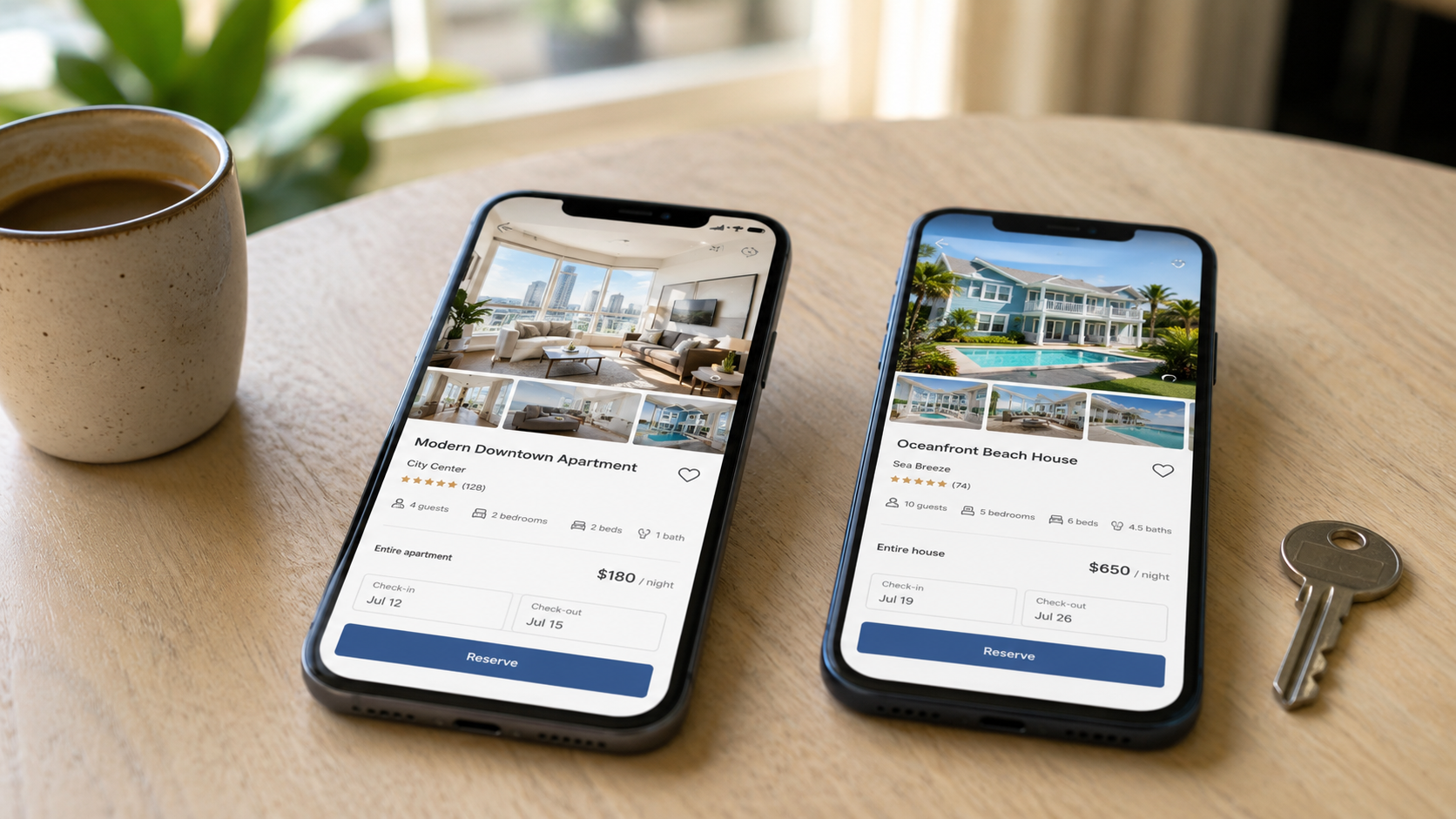
If you’re trying to decide between Airbnb vs Vrbo for hosts, the honest answer is: they’re built for different guests, charge fees differently, and give you different levels of control. Neither is universally better. But depending on your property type and location, one will almost certainly outperform the other — and knowing the difference can change your bottom line.
This guide covers the 2026 fee structures (both platforms made major changes in late 2025), cancellation policy control, payout timing, and what most comparison articles skip: how the guest audience difference actually affects your nightly rate strategy.
TL;DR: Airbnb vs Vrbo at a Glance
| Airbnb | Vrbo | |
|---|---|---|
| Host fee | 3% (host-only model) | ~8% (5% + 3% processing) |
| Guest fee | None (removed in late 2025) | 6–15% added at checkout |
| Guest type | Solo travelers, couples, urban stays | Families, groups, full-home stays |
| Cancellation control | Platform templates only | More host-defined flexibility |
| Payout timing | 24 hrs after check-in | 1 day after check-in, 3–5 days to bank |
| Best for | Urban apartments, rooms, unique stays | Beach houses, cabins, large vacation homes |
Who Actually Books on Each Platform
Before you look at fees, understand who you’re trying to attract — because the guest audience shapes everything else.
Airbnb draws a wide range of travelers: solo adventurers, couples, digital nomads, business travelers on extended stays, and people booking unique or urban properties. The platform’s “Experiences” feature and city-focused inventory have made it the default for short urban getaways.
Vrbo skews heavily toward families and groups booking full vacation homes — beach rentals, mountain cabins, lake houses, ski chalets. According to Hostaway’s 2026 analysis, Vrbo focuses on families, larger groups, and full-home vacation stays in resort-style markets.
The practical implication: if you have a one-bedroom apartment in a city, Vrbo will likely underperform. If you have a four-bedroom lake house, Airbnb might bring you shorter stays and higher turnover than Vrbo’s family bookings.
Fee Structure 2026: What You Actually Pay
This is where it gets important — and where most guides get it wrong by comparing outdated numbers.
Airbnb Fees in 2026
Airbnb made a significant change in late 2025: the guest-side service fee was removed from checkout. Under the current host-only pricing model, hosts pay approximately 3% per booking. Guests see the price you set with no service fee added on top.
The shift matters. Previously, guests saw a low nightly rate then faced a surprise service fee at checkout — which created high search-to-booking drop-off. Now what guests see is what they pay, which generally improves conversion. As a host, your 3% fee comes out of your payout automatically.
Note: If you use property management software with Airbnb’s API connection, fee structures may differ slightly. Check your specific PMS agreement.
Vrbo Fees in 2026
Vrbo operates on a pay-per-booking model: hosts pay roughly 8% total — a 5% commission plus 3% payment processing. On top of that, Vrbo adds a separate service fee to guests at checkout, typically 6–15%.
This means your direct cost as a host looks lower on Vrbo (8% vs. Airbnb’s effective rate), but guests pay more total than they would on Airbnb. For budget-sensitive travelers, that guest-side fee can reduce conversion. For families booking a $3,000 vacation week, it’s often less of a factor.
Vrbo previously offered a $499/year subscription plan that eliminated per-booking commissions for high-volume hosts. That model is being phased out — verify current availability in your market before relying on it.
What This Means for Pricing Strategy
Because the fee structures differ, many experienced hosts set different nightly rates on each platform. If your net target is $200/night, you need to price slightly higher on Vrbo to absorb the 8% take rate. Tools like Hostaway and Guesty allow channel-specific pricing rules so you’re not doing this math manually for every listing update.
Cancellation Policy Control
This is one of the most underappreciated differences between the two platforms.
Airbnb gives hosts preset templates: Flexible, Moderate, Firm, and Strict. You choose a template, but the platform retains authority. Airbnb’s extenuating circumstances policy can override your chosen terms — issuing full refunds to guests for reasons outside your pre-approved list. In 2026, this remains a significant friction point for hosts who built their revenue model around strict cancellation terms.
Vrbo gives hosts considerably more control. You can define your own refund terms, set your own penalty structure, and Vrbo generally enforces what you set. For hosts who’ve been burned by last-minute Airbnb cancellation reversals, this is a meaningful operational difference.
If revenue security and predictable occupancy matter more to you than maximizing booking volume, Vrbo’s cancellation structure is worth factoring into your platform choice.
Payout Timing
Both platforms hold your money longer than a direct booking would.
Airbnb releases your payout approximately 24 hours after guest check-in, then 3–5 business days to your bank account.
Vrbo releases one day after check-in, then adds 3–5 days to bank — marginally slower for the initial transfer, but functionally similar in practice.
Neither platform pays out before check-in by default, which means you’re extending credit on every reservation. For hosts managing cash flow across multiple properties, this timing compounds. It’s one reason direct booking and PMS tools that support payment processing on your own schedule become valuable as you scale.
Listing Visibility and Algorithm
Getting your listing in front of the right guests requires understanding how each platform ranks results.
Airbnb’s algorithm in 2026 prioritizes guest satisfaction signals, booking acceptance rates, and pricing competitiveness. Maintaining Superhost status requires a 4.8+ average rating — and recovering from a rating penalty requires 20–30 consecutive 5-star reviews. Response time and acceptance rate have an outsized early impact on new listings.
Vrbo’s algorithm rewards complete listings, calendar accuracy, response time, and review volume. The ranking mechanics are generally considered more transparent and more forgiving for new hosts building their review base.
One underappreciated Vrbo advantage: visibility across the Expedia Group’s full ecosystem. When you list on Vrbo, your property may also appear on Expedia, Hotels.com, and partner sites — giving you broader reach without additional listing work.
Which Platform Fits Your Property Type
Airbnb tends to outperform for:
- Studio and one-bedroom apartments in cities
- Unique or design-forward stays (treehouses, converted spaces, lofts)
- Properties near major attractions, airports, or business districts
- Hosts interested in offering Experiences alongside accommodation
- Short-stay markets (1–3 nights)
Vrbo tends to outperform for:
- Entire vacation homes (3+ bedrooms)
- Beach, lake, mountain, and resort-area properties
- Properties that attract families or groups of 4+
- Markets with longer average stays (5–10 nights)
- Hosts who prioritize fewer, higher-value bookings over volume
If your property could plausibly fit both categories — a 3-bedroom near both a city center and a lake, for example — test both platforms before committing to one.
Should You List on Both Airbnb and Vrbo?
For most hosts with a full vacation home, the answer is yes.
The two platforms attract meaningfully different audiences. Airbnb fills shoulder-season gaps with shorter urban getaways. Vrbo delivers high-value family bookings in peak season. Used together, they smooth occupancy across the calendar.
The operational complexity of managing two platforms — synced calendars, different pricing, two inboxes — is real but solvable. A channel manager or full PMS like Hostaway or Guesty handles calendar sync automatically and lets you adjust pricing per platform from a single dashboard. If you’re managing more than one property, the tool pays for itself quickly. For a full breakdown of what these tools cost and what they include, see our best vacation rental software guide.
Final Verdict: Airbnb vs Vrbo for Hosts
Choose Airbnb if you have an urban apartment, a unique property, or a space that attracts solo travelers and couples. The 3% host fee is competitive, and the platform’s traffic volume is unmatched for short-stay markets.
Choose Vrbo if you have a full vacation home targeting families or groups, particularly in leisure markets. The higher host fee (8%) is offset by higher average nightly rates, longer stays, and more control over your cancellation terms.
List on both if your property and market support it. The overhead is manageable with the right software, and the combined occupancy lift is usually worth it.
The question isn’t really Airbnb or Vrbo — it’s understanding which guests each platform sends you, and pricing accordingly.