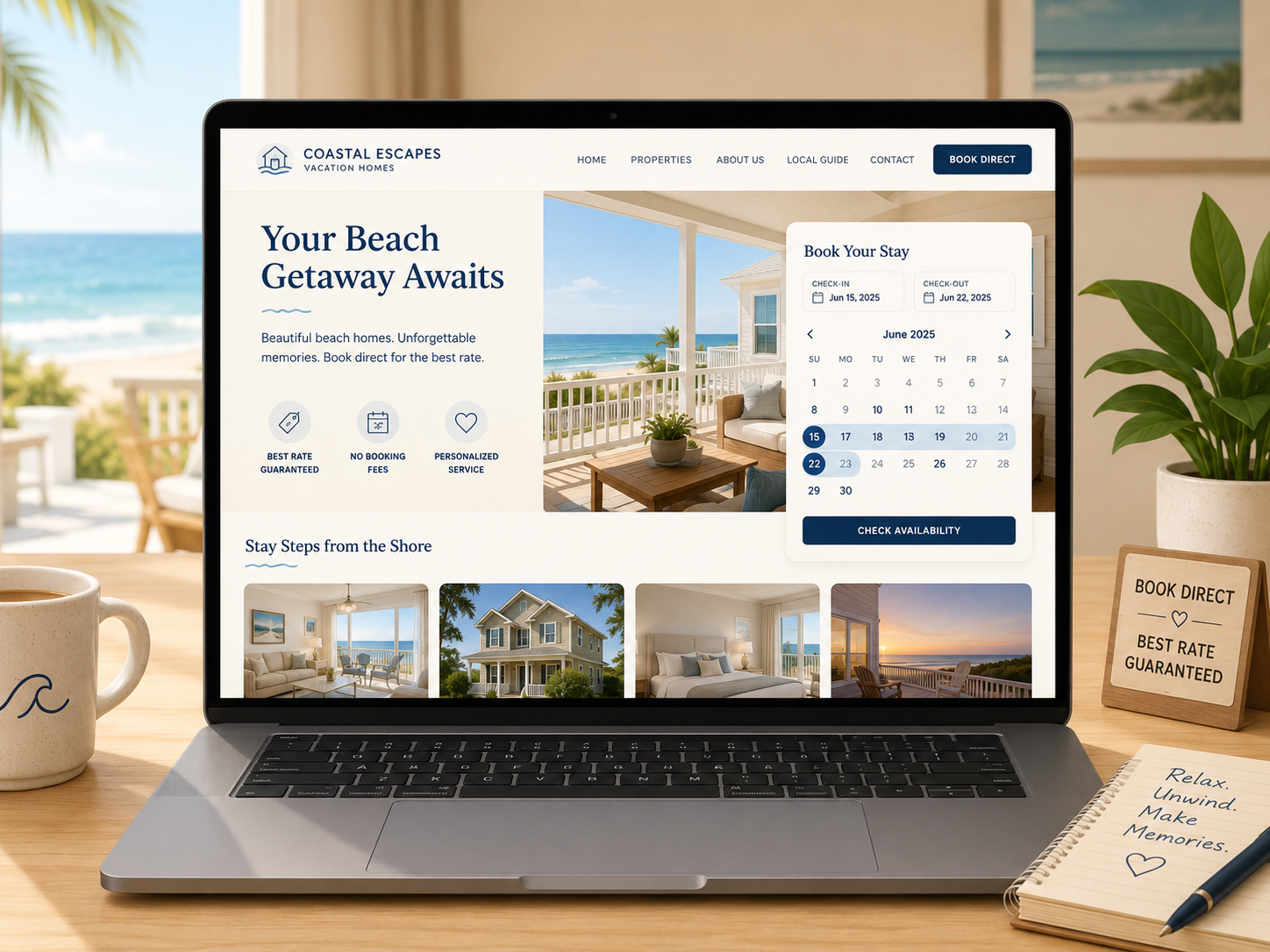
If you have ever watched 15-20% of a reservation disappear into Airbnb or Vrbo service fees, you already understand why a direct booking website builder has become one of the most searched tools in short-term rental management. A direct booking website builder lets hosts create their own branded reservation site, take commission-free bookings, and build a guest list they actually own instead of renting access to one from an OTA. In 2026, with OTA fees climbing and guest acquisition costs rising across the board, more hosts are treating a direct booking website builder as core infrastructure rather than a nice-to-have side project.
This guide breaks down what a direct booking website builder actually does, who needs one, and which tools are worth your time depending on your portfolio size and technical comfort level.
What a Direct Booking Website Builder Actually Does
At its core, a direct booking website builder combines three things: a content management layer for your property photos and descriptions, a real-time booking engine connected to your calendar, and a payment processor that lets guests pay you directly. The best direct booking website builder options also sync availability with your channel manager so you never risk a double booking between your own site and Airbnb or Vrbo.
Some hosts try to cobble this together with a generic website builder like Squarespace or Wix plus a third-party booking widget. That can work for a single property, but it gets fragile fast once you’re managing several units, because calendar syncing and payment handling are bolted on rather than built in. Purpose-built tools solve this by treating booking logic as the foundation, not an add-on.
According to research from Skift, OTA commissions remain one of the largest controllable cost categories for short-term rental operators, which is exactly why direct booking strategy keeps showing up in host forums and industry reports. A solid direct booking website builder is the most direct lever hosts have to claw some of that margin back.
Who Actually Needs a Direct Booking Website Builder
Not every host needs a dedicated site on day one. If you manage one or two listings and rely heavily on Airbnb’s search algorithm for discovery, the upfront effort of a direct booking website builder may not pay off immediately, since you still need traffic to convert. But if you have repeat guests, a property with a story worth telling (a unique cabin, a boutique building, a recognizable brand), or you’re running multiple units where even a 10% reduction in OTA dependency meaningfully moves your bottom line, a direct booking website builder quickly earns its place in your stack.
Property managers with 5+ units are the clearest case. At that scale, even modest direct traffic from repeat guests, email lists, or local SEO can offset thousands of dollars a year in avoided commissions.
Top Direct Booking Website Builder Options for 2026
Hostaway
Hostaway is best known as a full property management system, but it ships with a built-in direct booking website builder as part of its core platform rather than as a bolt-on extra. Hosts can spin up a branded, mobile-optimized booking site connected directly to their live calendar and channel manager, so availability stays accurate across Airbnb, Vrbo, and the direct site simultaneously. For hosts already considering a PMS upgrade, getting a capable direct booking website builder bundled in is a strong reason to put Hostaway on the shortlist. You can try Hostaway free → to see how the booking engine looks with your own listings loaded in.
Guesty
Guesty takes a similar bundled approach, offering a direct booking website builder alongside its broader property management and channel management suite. Guesty’s version leans into customization for larger portfolios and multi-unit brands, with options to reflect different property collections or sub-brands within one account. It’s a solid fit for property managers who want their direct booking website builder to scale alongside a growing unit count without needing a separate web development project each time they add inventory. Hosts evaluating the platform can start with Guesty → to test the builder against their current portfolio size.
Lodgify
Lodgify is one of the more popular standalone options, marketed specifically as a direct booking website builder rather than a full PMS. It’s a reasonable entry point for hosts who want a dedicated booking site without committing to an entire property management overhaul, though hosts managing several units often eventually want the deeper calendar and channel sync that comes from pairing a builder with a true PMS.
Your Own Site Plus a Booking Widget
For hosts who already have a website (built in WordPress, Squarespace, or similar) and just want to add booking functionality, several standalone booking engine widgets can be embedded directly into existing pages. This route keeps your existing branding and content intact while adding direct booking capability, though it does require more manual setup of calendar sync rules to avoid conflicts with your OTA listings.
How to Choose the Right Direct Booking Website Builder
When comparing a direct booking website builder, weigh four factors: how tightly it syncs with your existing channel manager, what percentage commission (if any) it charges on direct bookings, how much design flexibility it offers without requiring a developer, and whether it includes built-in SEO basics like clean URLs, fast load times, and schema markup for search visibility.
Pricing models vary meaningfully. Some direct booking website builder tools charge a flat monthly fee with no per-booking commission, which rewards hosts who can drive consistent direct traffic. Others charge a small percentage per direct booking, which feels more affordable upfront but can add up at scale. Run the math against your expected direct booking volume before committing.
It’s also worth checking integration depth with your existing tools. If you’ve already chosen a PMS, as outlined in our guide to choosing a vacation rental PMS, checking whether that platform includes a native direct booking website builder can save you from running two disconnected systems and managing calendar sync manually.
A report from Skift Research on travel distribution consistently shows that diversifying booking channels protects revenue against algorithm changes and fee increases on any single platform, which is the strategic case for investing in a direct booking website builder even if OTAs remain your primary channel for the foreseeable future.
Getting Traffic to Your Direct Booking Website
A direct booking website builder solves the technical side, but it won’t generate traffic on its own. The hosts who see real returns typically pair their site with an email list of past guests, local SEO content about their destination, and a simple referral incentive for guests who book again directly. Even modest traffic, paired with a frictionless booking flow, often converts better than you’d expect, since repeat guests already trust you and would rather avoid OTA fees themselves when possible.
Don’t expect a direct booking website builder to replace OTA traffic overnight. Think of it as a long-term asset that compounds: every guest who books direct and has a great stay becomes more likely to book direct again next time, gradually shifting your channel mix in your favor.
Common Mistakes Hosts Make With a Direct Booking Website Builder
Even with the right direct booking website builder in place, a few avoidable mistakes keep hosts from seeing results. The first is launching a beautiful site with no plan to drive traffic to it, then concluding direct bookings “don’t work” within a few weeks. Organic traffic and repeat-guest conversion both take months to build momentum, so treat the first quarter as setup rather than results.
The second mistake is letting calendar sync lag between the direct booking website builder and your OTA listings. Even a short delay can cause a double booking, which costs far more in guest trust and refunds than any commission you saved. Always confirm your builder syncs in real time, not on a delayed batch schedule, before you start promoting your direct site publicly.
The third mistake is pricing direct bookings the same as OTA listings with no incentive to book direct. A small discount, free early check-in, or bundled extra (like a welcome basket) gives repeat guests a concrete reason to skip Airbnb next time, which is often what finally moves the needle on adoption.
Final Thoughts
A direct booking website builder isn’t going to eliminate your dependence on Airbnb or Vrbo overnight, but it gives you a real alternative channel and starts shifting bookings toward lower-fee, higher-margin reservations over time. If you’re already comparing property management systems, prioritize ones with a strong native direct booking website builder rather than treating it as a separate purchase.
Ready to see what a built-in direct booking website builder looks like with your own properties loaded in? Try Hostaway free → or explore Guesty’s platform → and compare the booking engine experience for yourself before you commit to a full PMS migration.