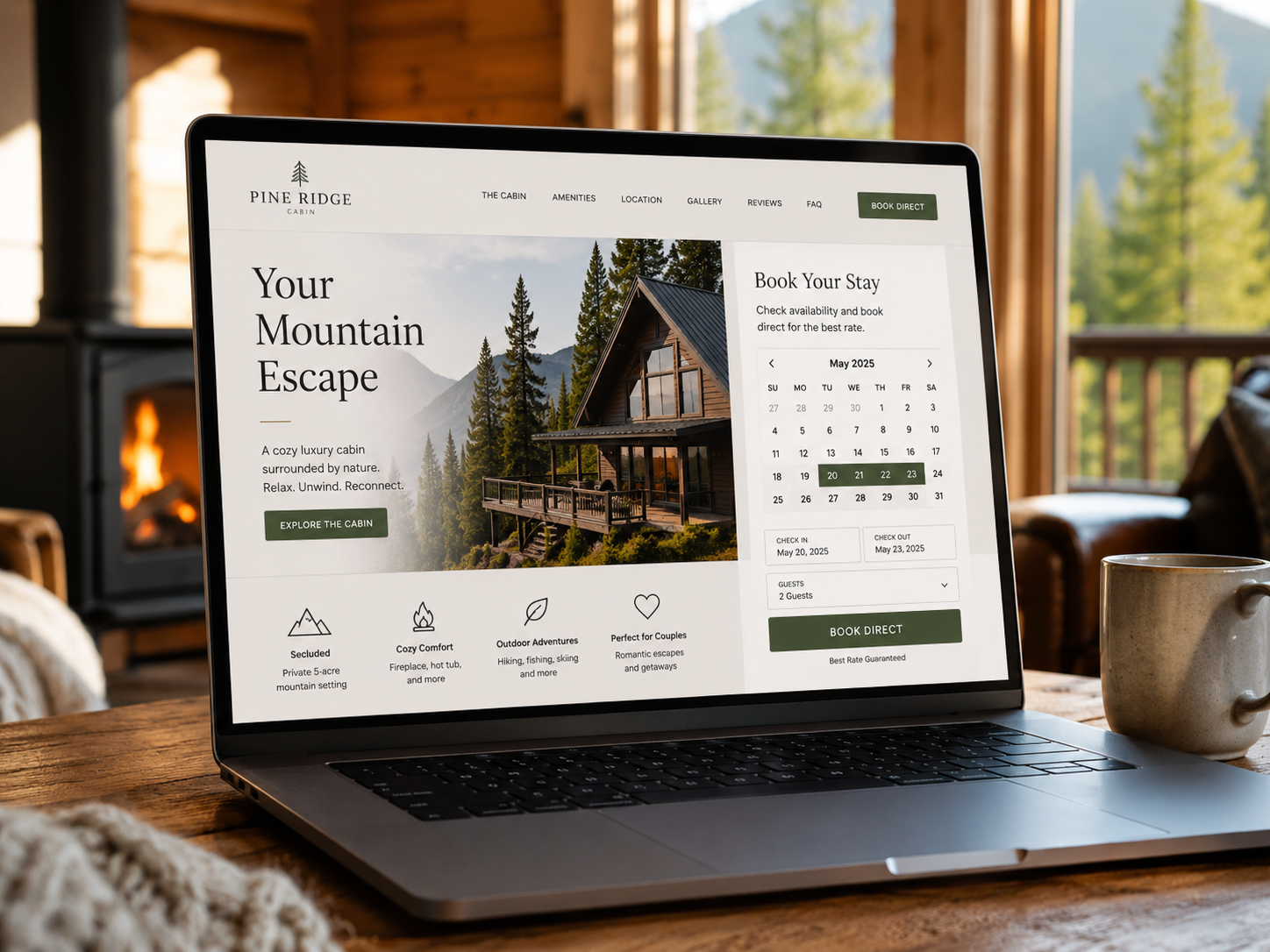
If you’ve ever watched 15-18% of a reservation evaporate into an OTA commission, you already understand why a direct booking website has become one of the most talked-about upgrades in short-term rental hosting. A direct booking website lets guests reserve straight from you, with no Airbnb or Booking.com fee sitting between you and your revenue. In 2026, with OTA competition tighter than ever and guest acquisition costs climbing, more hosts are treating a direct booking website less like a nice-to-have and more like core infrastructure for their business.
The catch is that not every direct booking website builder is created equal. Some are bare-bones page builders bolted onto a PMS. Others are full marketing engines with SEO tools, abandoned-cart recovery, and built-in payment processing. This guide breaks down the best direct booking website options for hosts in 2026, what each one actually does well, and how to decide which fits your portfolio size.
Why a Direct Booking Website Matters in 2026
Industry research has consistently shown how much commission structures eat into host margins. According to data cited by Skift Research, OTA commissions on short-term rentals commonly range from 12% to 20% per booking, depending on the platform and listing tier. Multiply that across a portfolio of even five or six properties, and a host can lose tens of thousands of dollars a year that could otherwise fund renovations, better cleaning crews, or simple profit.
A direct booking website attacks that problem from two angles. First, it gives repeat guests — the ones who already loved your property — a frictionless way to rebook without paying platform fees or risking the listing being unavailable. Second, it gives you a place to send traffic from email lists, social media, and local SEO so you’re not 100% dependent on OTA algorithms for visibility. Hosts who build an audience over a few seasons often find their direct booking website starts capturing a meaningful share of repeat and referral business, sometimes 15-30% of total nights depending on niche and location.
It’s worth noting a direct booking website doesn’t replace OTAs entirely — it works alongside them. Airbnb and Vrbo remain critical for new guest discovery, which we cover in our Airbnb vs Vrbo comparison. The direct booking website is the layer you add on top once you have some guest history to work with.
What to Look for in a Direct Booking Website Builder
Before comparing tools, it helps to know what actually separates a good direct booking website from a forgettable one.
A strong direct booking website builder should include a live availability calendar synced to your PMS or channel manager, so you never risk a double booking. It should support secure online payments, ideally with deposit and damage-protection options built in. SEO basics matter too — clean URLs, fast load times, and editable meta tags so your property pages can actually rank in local search. Finally, look for email capture and automated guest messaging, since the real payoff of a direct booking website compounds over multiple stays, not just the first one.
1. Hostaway’s Direct Booking Website Tools
Hostaway, one of the most established all-in-one PMS platforms, bundles direct booking website functionality directly into its core product rather than treating it as an add-on. Hosts get a branded, mobile-responsive site with real-time availability pulled straight from the PMS calendar, integrated payment processing, and customizable property pages that support photos, house rules, and upsells like early check-in or airport transfers.
Because the direct booking website lives inside the same system that manages your reservations, cleaning schedules, and guest messaging, there’s no separate sync layer to break. For hosts already managing multiple listings, this consolidation is often the biggest time-saver. Hostaway also layers in marketing tools like email automation to nudge past guests back toward booking direct on their next trip. Try Hostaway free →
2. Guesty’s Booking Engine and Website Builder
Guesty takes a similar all-in-one approach with its booking engine, which powers a direct booking website that’s automatically kept in sync with availability across every connected channel. Guesty’s site builder leans into customization, letting larger property managers maintain brand consistency across dozens or hundreds of units while still giving each property page room for unique descriptions and photography.
Guesty’s direct booking website also supports multi-property search, which matters a lot for management companies running entire buildings or neighborhoods rather than a single listing. Combined with Guesty’s broader automation suite, the booking engine becomes one more channel feeding the same unified inbox and reporting dashboard. Explore Guesty’s platform →
3. Lodgify
Lodgify built its reputation specifically around direct booking website creation for independent hosts and small portfolios. Its drag-and-drop builder is approachable for hosts without technical experience, and templates are designed to convert visitors into bookers with prominent calendar widgets and instant-quote tools.
Lodgify pairs the website with its own lightweight PMS and channel manager, so smaller operators can run an entire business — calendar sync, payments, guest communication, and the direct booking website itself — from one dashboard. Learn more directly at lodgify.com.
4. Your Porter App
Your Porter App focuses heavily on the marketing side of a direct booking website, with built-in abandoned-cart email sequences, upsell offers, and integrations with email platforms like Mailchimp. It’s a popular pick among hosts who already have a PMS they like and just need a dedicated direct booking website plus the automation to drive traffic to it.
5. Boostly’s Direct Booking Templates
Boostly started as a marketing agency for vacation rental hosts and expanded into website templates purpose-built to convert. Their direct booking website packages emphasize trust signals — reviews, guarantees, local guides — that are often missing from generic templates, aimed at hosts trying to compete with the polish of major OTA listing pages.
6. Hospitable’s Direct Booking Site
Hospitable, primarily known for guest messaging automation, also offers a direct booking website feature aimed at hosts who want a simple, fast-to-launch option tied into the same system handling their guest communication and pricing rules.
7. WordPress + a Booking Plugin
For hosts who want full design control, building a direct booking website on WordPress with a booking plugin (such as a calendar and payment plugin) remains a legitimate option. It takes more setup time and some comfort with website maintenance, but it offers the most flexibility for hosts who want their site to double as a broader brand or blog, not just a booking page.
How to Choose the Right Direct Booking Website for Your Portfolio
If you’re running one or two properties and want everything in one place, a PMS-bundled direct booking website like the ones from Hostaway or Guesty usually makes the most sense, since you’re not paying for or maintaining a separate tool. If you’re an independent host without a full PMS yet, a dedicated builder like Lodgify can get you live faster. And if marketing automation is your priority over design, tools like Your Porter App or Boostly fill that gap well.
Whichever direct booking website you choose, the real driver of results isn’t the software itself — it’s whether you actively send traffic to it. Email your past guests after checkout, add the link to your Wi-Fi card and welcome book, and mention it in your OTA messaging where platform rules allow. A direct booking website with no visitors won’t move your numbers, but a modest one with a steady trickle of repeat traffic often pays for itself within a season or two.
Final Thoughts
A direct booking website isn’t going to replace Airbnb or Vrbo overnight, and it shouldn’t try to. Think of it as the long-term investment that slowly shifts a growing share of your bookings away from commission fees and toward guests who already trust you. Start with whichever tool fits your current stack: if you’re already evaluating a full PMS, Hostaway and Guesty both fold the direct booking website in as part of a broader system, which is worth weighing against running a standalone builder. Try Hostaway free → or explore Guesty’s booking engine → to see which fits your portfolio.
Frequently Asked Questions About Direct Booking Websites
Do I need a PMS to have a direct booking website? No, but it helps. Standalone builders like Lodgify can run a direct booking website on their own, while PMS-bundled options like Hostaway and Guesty sync the website directly to your existing reservation calendar so availability never drifts out of date.
Will a direct booking website hurt my Airbnb ranking? Not directly. Airbnb doesn’t penalize listings for having an external direct booking website, though you should always follow each platform’s messaging policies when mentioning it to guests within their system.
How long does it take to see results from a direct booking website? Most hosts report it takes one to two full booking seasons before a direct booking website generates meaningful repeat or referral volume, since it depends on building a guest list and review history first.