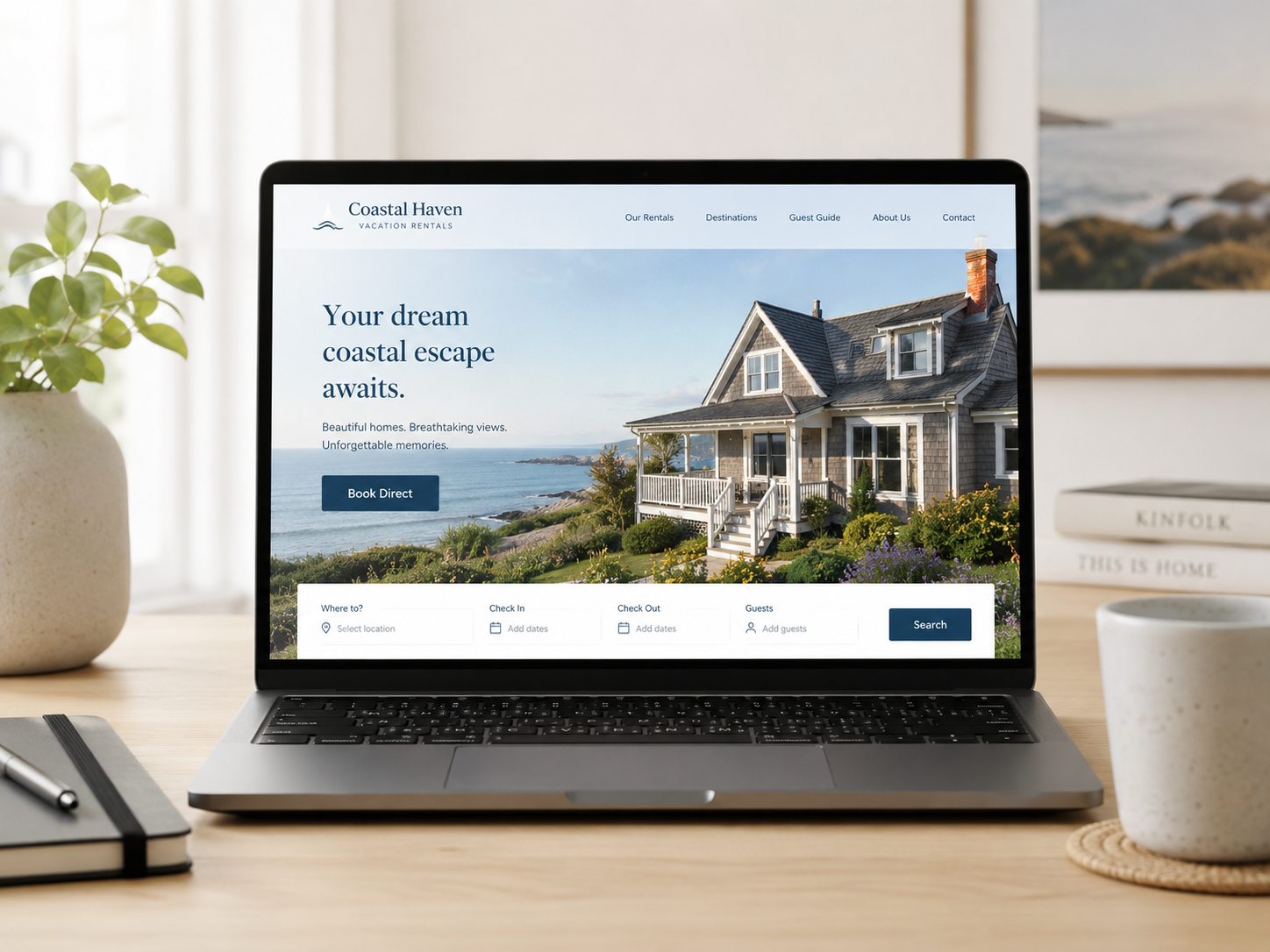
If you rent on Airbnb or Vrbo, you already know the pinch: 15% to 20% of every reservation disappears into platform fees before you see a dollar. A direct booking website is the single most powerful way to change that math. By sending guests to your own site, you keep the commission, own the guest relationship, and stop competing against thousands of look-alike listings. This guide walks through why a direct booking website matters in 2026, the seven best tools to build one, and a practical setup plan any host can follow, even without a technical background.
Why a Direct Booking Website Is Worth It in 2026
The case for going direct comes down to money, data, and control. On the big online travel agencies (OTAs), you rent access to their audience, but you never actually own it. When a guest books through Airbnb, that guest belongs to Airbnb.
A direct booking website flips the relationship. You capture the guest’s email, phone number, and booking history, which means repeat stays and referrals cost you nothing. Industry research from Skift consistently shows that direct channels carry the highest margins in travel, and short-term rentals are no exception.
There is also a resilience angle. Platform policy changes, sudden account suspensions, and search-ranking shifts can wipe out your bookings overnight. Hosts who rely on a single OTA have no safety net. A direct booking website is an asset you control, and it keeps earning even when a platform changes the rules. Consider the lifetime value too: a guest who books direct three times over two years is worth far more than a one-off OTA stay, and none of that repeat revenue carries a commission.
Finally, guests increasingly want to book direct too. Many travelers Google a property name after finding it on an OTA, hoping for a better rate. If you have no site, that intent is lost. If you do, you capture a full-price, fee-free reservation.
What a Direct Booking Website Actually Needs
Before comparing tools, it helps to know the moving parts. A functional direct booking website is more than a pretty landing page; it needs to accept reservations and stay in sync with your other channels.
At minimum you need a booking engine that shows live availability and takes payment, a calendar that syncs two-ways with Airbnb and Vrbo so you never double-book, and a secure payment processor such as Stripe. You will also want automated guest emails, a mobile-friendly design, and basic search-engine optimization so travelers can find you.
The good news: modern property management systems bundle most of this together. You rarely have to stitch tools together by hand anymore.
The 7 Best Direct Booking Website Tools for Hosts
Here are the platforms worth considering, from all-in-one management systems to lightweight site builders.
1. Hostaway — Best All-in-One Direct Booking Website
Hostaway pairs a full property management system with a built-in direct booking website and reservation engine. Your calendar, pricing, and guest messaging all live in one dashboard, and the site syncs automatically with Airbnb, Vrbo, and Booking.com. For hosts who want everything under one roof, it is the strongest option, and its marketplace of integrations covers dynamic pricing, smart locks, and cleaning tools. Try Hostaway free →
2. Guesty — Best for Growing Portfolios
Guesty is built for hosts and property managers scaling past a handful of units. Its direct booking website module includes a customizable site, an integrated booking widget, and marketing tools to nudge repeat guests. If you manage many listings across multiple owners, Guesty’s automation and reporting are hard to beat. Start with Guesty →
3. Lodgify — Best Standalone Website Builder
Lodgify focuses specifically on building rental sites. Its drag-and-drop editor, templates, and built-in booking engine make it a favorite for hosts who want a polished site without a full PMS. It also offers a channel manager to keep OTAs in sync.
4. OwnerRez — Best for Serious Automation
OwnerRez is beloved by experienced hosts for its deep automation, robust WordPress plugin, and flexible booking widgets. The learning curve is steeper, but the control is unmatched for a direct booking website that needs custom rules.
5. Uplisting — Best Simple Direct Booking Widget
Uplisting keeps things clean and fast. Its hosted booking page and embeddable widget let you take direct reservations with minimal setup, making it a good pick for hosts who value simplicity.
6. Hostfully — Best Guest Experience Add-Ons
Hostfully combines a booking site with digital guidebooks that upsell services and delight guests. If part of your direct strategy is memorable stays that drive referrals, it is worth a look.
7. WordPress + a Booking Plugin — Best for Full Ownership
If you want total control and are comfortable with a little tech, a self-hosted WordPress site with a booking plugin gives you the most flexibility and no monthly platform lock-in. It demands more maintenance, but you truly own every pixel.
How to Build Your Direct Booking Website Step by Step
You do not need to be a developer to launch. Follow this sequence and you can have a working site in a weekend.
Start by choosing your tool from the list above based on how many properties you run and how hands-on you want to be. Next, register a memorable domain name that matches your property or brand, since a custom domain builds trust and improves SEO.
Then connect your booking engine and payment processor, import your photos and descriptions, and set your rates and rules. Crucially, link your calendar so the direct booking website syncs two-ways with your OTA listings, preventing double bookings.
Before you go live, test a dummy reservation from a guest’s point of view. Make sure confirmation emails fire, payment clears, and the mobile layout looks clean. Small friction points cost real bookings.
Driving Traffic to Your Direct Booking Website
A beautiful site with no visitors earns nothing. The whole point of a direct booking website is to convert demand you already have, so start with the audience closest to you.
Add your site link to your Airbnb and Vrbo profiles where allowed, and put it in every guest checkout message and follow-up email. Past guests are your warmest leads; a simple “book direct next time and save” note works. Build a small email list and send occasional off-season offers.
Beyond your existing guests, invest in local SEO, a Google Business Profile, and a few social posts showcasing the property. For a deeper playbook, see our guide on the best guest communication software for vacation rental hosts, which pairs perfectly with a direct strategy.
Common Mistakes to Avoid
The most frequent misstep is treating a direct booking website as “set it and forget it.” Rates drift out of date, photos get stale, and broken sync creeps in. Schedule a monthly review.
Another trap is skipping guest trust signals. Travelers booking outside a big platform want reassurance, so display reviews, clear cancellation terms, secure-payment badges, and responsive contact info. Damage protection and travel insurance options also ease hesitation.
Finally, do not abandon the OTAs entirely. The smart play is a hybrid: use Airbnb and Vrbo for discovery, then convert repeat and referral guests to your direct booking website where margins are higher.
Direct Booking Website FAQ
How much does a direct booking website cost? Most hosted tools run between $20 and $50 per property per month, sometimes bundled inside a broader management subscription. A self-hosted WordPress setup can be cheaper monthly but takes more of your time. When you weigh the cost against saving 15% to 20% on every OTA reservation, a direct booking website usually pays for itself after just a few bookings.
Will a direct booking website hurt my Airbnb ranking? No. Running your own site does not affect how Airbnb ranks your listing. The two channels operate independently, and a hybrid approach is exactly what most successful hosts use: OTAs for discovery, your own site for repeat and referral guests.
Do I need to be technical to launch one? Not anymore. Platforms like Hostaway, Guesty, and Lodgify handle hosting, payments, and calendar sync for you, so most hosts can build a complete direct booking website in a weekend with no coding at all. Only the fully self-hosted route asks for real technical comfort.
How do guests find my site? Traffic comes from three main places: your existing guests (via checkout messages and email), search engines (through a custom domain and local SEO), and social media. The warmest leads are always people who have already stayed with you, which is why capturing guest contact details is so valuable.
Final Thoughts: Own Your Bookings in 2026
A direct booking website is no longer a nice-to-have for serious hosts; it is the foundation of a profitable, resilient rental business. It lowers your fees, protects you from platform risk, and turns one-time guests into repeat customers who book direct year after year.
If you want the fastest path with everything in one place, an all-in-one platform is the way to go. Launch your direct booking website with Hostaway → or, if you are scaling a larger portfolio, explore Guesty’s booking tools →. Either way, the sooner you go direct, the sooner you stop paying for guests you already earned.