Every host who has watched a 15% Airbnb service fee disappear from a payout knows the appeal of booking guests directly. That is exactly why vacation rental direct booking software has become one of the fastest-growing categories in hospitality tech this year. Instead of relying entirely on Airbnb, Vrbo, or Booking.com, hosts are building their own branded websites, capturing guest emails, and rebooking repeat travelers without paying a cut to a third party. If you manage even two or three properties, the math adds up quickly, and the right software makes the switch painless.
In this guide, we will walk through what vacation rental direct booking software actually does, which platforms do it best, and how to combine it with your existing channel manager so you never lose a booking to double-availability errors.
What Is Vacation Rental Direct Booking Software?
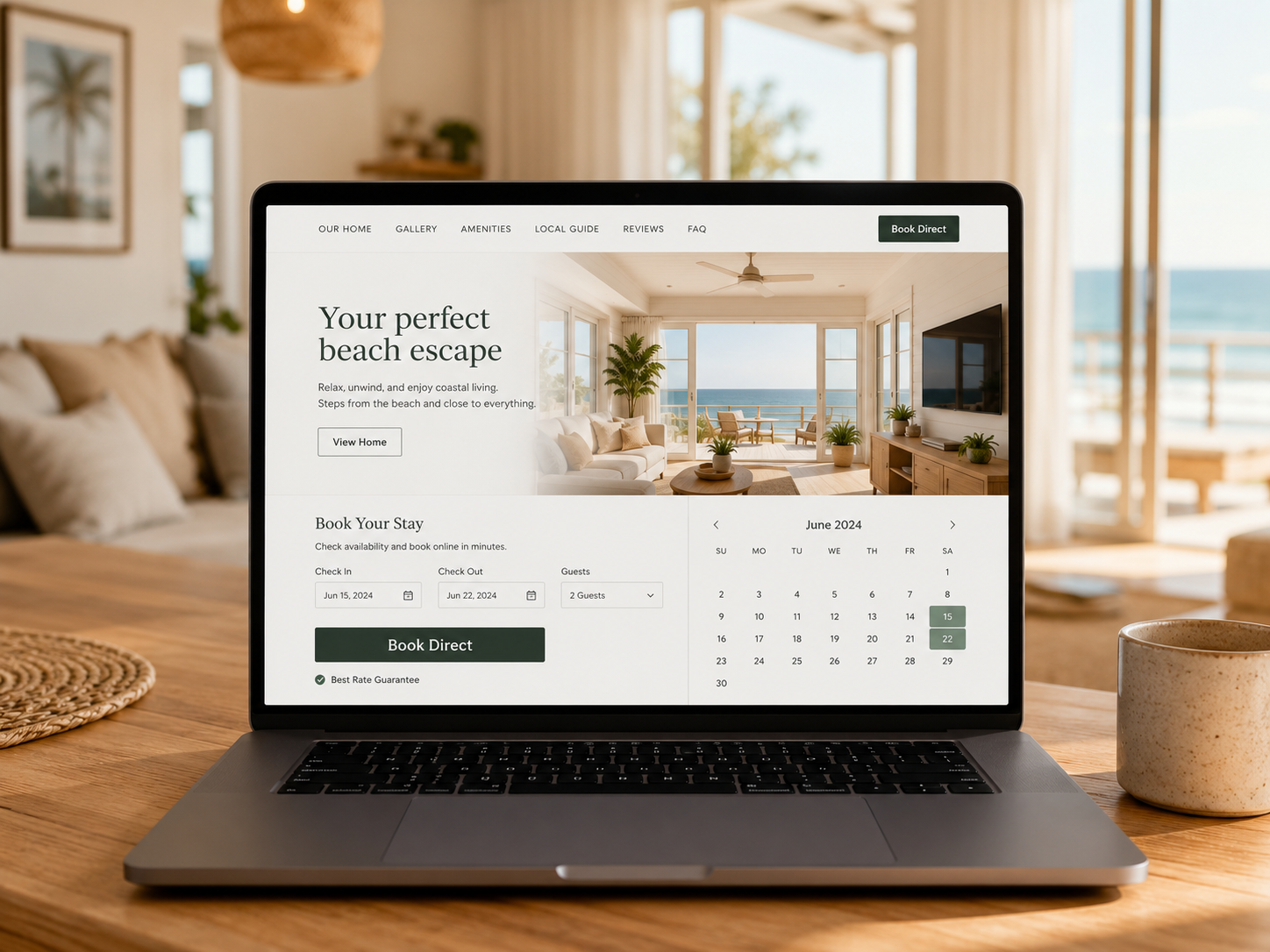
At its core, this type of software gives you a standalone, mobile-friendly website where guests can search your calendar, see real-time pricing, and pay you directly. It pulls availability from your property management system (PMS) so your direct site, Airbnb listing, and Vrbo listing all stay in sync. No more manually blocking dates after a guest books through your own site.
The best vacation rental direct booking software also includes a secure payment processor, automated confirmation emails, and SEO-friendly listing pages so your property can actually rank on Google. Some platforms go further, adding upsells like early check-in, late checkout, or a welcome basket that guests can add during checkout.
Why Hosts Are Prioritizing Direct Bookings in 2026
OTA commissions have not gotten any cheaper, and guest acquisition costs on platforms like Airbnb continue to rise as competition for top search placement intensifies. According to research from STR (a CoStar company), average daily rates and OTA dependence have both climbed steadily across the short-term rental sector, squeezing host margins even as occupancy holds steady.
Direct bookings solve three problems at once: they remove the OTA commission entirely, they let you build a real email list of past guests for remarketing, and they give you full control over your cancellation policy and house rules instead of being bound by platform-wide defaults. For a deeper look at how this fits into your overall tech stack, see our PMS buyer’s guide.
Top Vacation Rental Direct Booking Software Options
Hostaway
Hostaway is best known as a full-service PMS, but its built-in direct booking website generator is genuinely strong. It auto-builds a custom domain site from your existing listing content, syncs rates and availability in real time across every channel, and includes a guest CRM that flags repeat guests for personalized discounts. Because it is already a unified vacation rental direct booking software and channel manager, you avoid the sync headaches that come from stitching together separate tools.
Hosts running 5+ units tend to see the fastest payback, since the monthly subscription is easily offset by even one or two direct bookings per month. If you want to see how it stacks up firsthand, you can try Hostaway free →.
Guesty
Guesty takes a similar all-in-one approach, with its “Guesty Booking Engine” generating a direct booking website tied to your property listings and a unified inbox for guest messaging. It is particularly well suited to hosts managing a larger or mixed portfolio, since the platform scales smoothly from a handful of units into the hundreds without major workflow changes.
Guesty’s direct booking pages also support multi-property search, which is useful if you operate several listings in the same building or neighborhood and want guests to compare options without leaving your site. You can explore the full feature set and start with Guesty →.
Lodgify
Lodgify is a popular standalone option for hosts who want a dedicated direct booking website without committing to a full PMS migration. It connects to Airbnb and Vrbo through their official APIs, so your calendar stays synced, and it offers solid customization for hosts who want a more branded look and feel than a typical templated site.
OwnerRez
OwnerRez has built a loyal following among hosts who manage a mix of vacation rentals and need granular control over trust accounting, custom quote workflows, and detailed reporting. Its direct booking sites are less flashy visually but extremely configurable, which appeals to operators who want full control over every field a guest sees at checkout.
How to Choose the Right Direct Booking Setup
Picking the right vacation rental direct booking software depends largely on where you are starting from. If you already use a PMS for channel management, check whether it includes a direct booking site before adding a third tool, since fewer integrations generally mean fewer sync errors. If you are running a larger portfolio, prioritize platforms that handle multi-property search and guest CRM data well, since repeat-guest remarketing is where most of the long-term ROI comes from.
It also helps to look at how a platform handles SEO. A direct booking website that never ranks on Google is really just a digital business card; it will not pull in new traffic on its own. Look for built-in schema markup, fast page speeds, and the ability to write custom page content, since these technical details determine whether guests can actually find your direct booking software pages through organic search. The Google Search Central documentation is a useful reference if you want to understand what search engines look for in a booking site.
Integrating Direct Booking Software With Your Channel Manager
One detail that trips up a lot of hosts is assuming a direct booking website operates independently from their existing channel manager. In reality, the best setups treat your direct site as just another “channel” feeding into the same central calendar that already syncs Airbnb, Vrbo, and Booking.com. This is why most vacation rental direct booking software is now bundled directly into PMS platforms rather than sold as a bolt-on extra.
If you are already using a dedicated channel manager, confirm that it supports two-way sync with whichever direct booking tool you choose. A one-way sync, where bookings flow out but availability does not flow back in correctly, is a common source of double bookings. Run a test reservation through your direct site before sending real traffic to it, and confirm the corresponding block appears instantly on your other listing channels.
It is also worth checking how your direct booking software for vacation rentals handles payment processing and currency. Hosts who attract international guests benefit from a tool that supports multiple currencies and local payment methods, since a payment page that only accepts USD cards will quietly lose bookings without ever showing up as an obvious problem in your analytics.
Measuring the ROI of Your Direct Booking Channel
Once your site is live, track a few simple numbers monthly: total direct bookings, average booking value, and the percentage of your overall revenue coming through the direct channel versus OTAs. Most hosts find that even a modest 10 to 15 percent share of direct bookings meaningfully changes their annual commission spend, since that revenue carries no OTA fee at all.
It also helps to track where direct traffic originates. If most direct bookings come from repeat guests rather than new search traffic, that tells you your vacation rental direct booking software is doing its job on retention, and you may want to invest more in SEO content or paid ads to capture new visitors as well.
Common Mistakes Hosts Make With Direct Bookings
A lot of hosts launch a direct booking website and then forget to actually drive traffic to it. Adding your direct site link to your Airbnb messaging templates, your Instagram bio, and your post-stay email is a simple way to start converting repeat guests. Skipping this step is the single biggest reason direct booking software underperforms its potential.
Another common mistake is pricing the direct site identically to OTA listings without passing along any of the savings. Offering a small discount, say 5 to 10 percent, for direct bookings gives guests a real incentive to skip the OTA and rewards your most loyal repeat travelers.
Final Thoughts
Vacation rental direct booking software is no longer a nice-to-have for serious hosts; it is becoming a core part of how profitable operators protect their margins against rising OTA fees. Whether you choose an all-in-one PMS approach or a standalone booking site tool, the goal is the same: capture more of your guest relationship and keep more of every dollar you earn.
If you are already comparing platforms, both Hostaway and Guesty bundle direct booking capability with full PMS and channel management, which makes them a strong starting point for most hosts. You can try Hostaway free → or start with Guesty → to see which fits your portfolio size and workflow better, and start building the direct booking channel your business has been missing.